
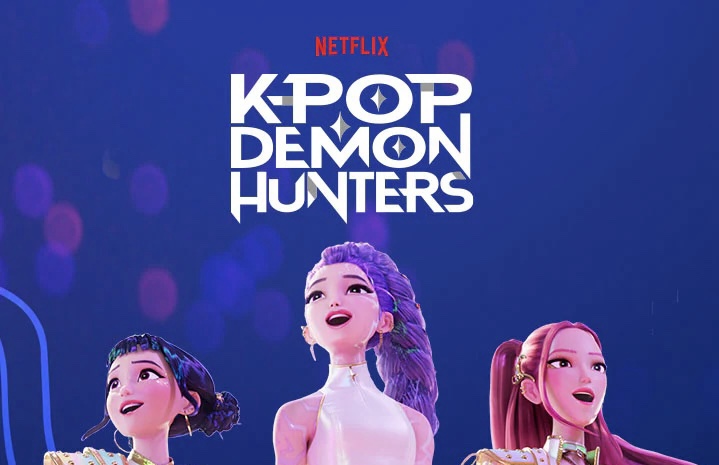
It’s 2025 and if you have children you’ve heard of K-pop Demon Hunters. It has swept pop culture with dazzling high octane songs that promise, “we’re going up, up, up with our voices, gonna be, gonna be, golden.” But what is it all about? It has the word “demon” in the title. Should we be afraid? I’ve seen Christian thinkers have reservations about this pop culture vehicle so I decided to face it with my kids and watch the film. Let’s walk through it.
First, the “K” in K-pop stands for Korean. Within the K-pop market is the “idol system”. It is a highly organized industry model that trains, manages, and promotes performers known as idols. It’s unlike most Western music paths and is closer to a talent-factory system. The artists audition for entertainment companies, groups are engineered, there is a huge fan interaction system where fans directly build the group’s popularity. Even after the stars have “made it” they are still captured by their management and continue with their training; they are still trainees. It is a machine and there is not much autonomy.
In the film, the demon hunters are “trainees” under the pressures of the idol system including carnivorous fans, the facade of having a pure image, the high pressure of performing with bright personas while fighting in the shadows, the entertainment company becomes an authoritarian force. All the themes are metaphors for the exploitation in the idol system. The idols fight demons we can’t see.
The film explores Korean culture, mythology and folklore. Specifically the oldest belief system in Korea: Shamanism. The demon-hunting powers of the main group, HUNTR/X, are inspired by mudang — Korean shamans (traditionally women) who perform ritual dances, songs, and exorcisms. In the film, their singing builds a magical barrier (called the Honmoon) that wards off evil spirits. The Saja Boys (the rival K-pop group) are based on jeoseung saja, the reapers in Korean myth who guide souls to the afterlife. In the film, their idol personas mask something more sinister — they “steal” souls, which reimagines their role in a more antagonistic way.
If you’re like me, you see Christian motifs in this film too. It’s no surprise. Christian framing is also embedded in Korean culture because 30% of Koreans are Christian. I see the Christian theme of shame deepening the effects of sin by driving us into hiding rather than truth and repentance. Look at these lyrics from the songs Golden and This is What it Sounds Like:
“I was a ghost, I was alone”
“I am the worst of what I came from, patterns I’m ashamed of, things that even I don’t understand“
And the burden of that sin:
Golden; “I lived two lives, tried to play both sides, but I couldn’t find my own place”
The need for confession:
Golden; “I’m done hiding”
What it Sounds Like; “My voice without the lies, this is what it sounds like”
Redemption:
Golden; “Now I’m shining, like I’m born to be”
What it Sounds Like; “I should’ve let the jagged edges meet the light instead.”
Redemption transforming us, regenerating us, into people who show an outpouring of truth, forgiveness, love and gratitude as fallible human beings made in the infallible image of God. In other words- we have worth.
Now, let me be careful, there is no mention of any religious figures. There is no God, no eternal savior, but that doesn’t negate the reality and universality of common grace and the value of imagination, mysticism, and the world of enchantment. As G.K. Chesterton asserts:
What was heathen was still human; that is, it was both mystical and material.
Children’s art takes artistic liberties and delves into the world of enchantment- there is magic, fictional imagery, creatures and goblins, metaphor, dark versus light, spiritual battles, victory and loss. This exploration in art adds depth to imagination and our understanding of life. In my opinion, it certainly shouldn’t be “banned”. Many art forms hint at the divine.
C.S. Lewis, Christian author of many sci-fi and fantasy books said:
“Fairy-land arouses a longing … It stirs and troubles him … with the dim sense of something beyond his reach … and, … far from dulling or emptying the actual world … gives it a new dimension of depth.”
While K-pop Demon Hunters doesn’t make the leap to the divine, it does wrestle with spiritual forces on earth. It yearns for honesty and harmony, a perfect balance that will never be found on earth. C.S. Lewis also said:
“If we find ourselves with a desire that nothing in this world can satisfy, the most probable explanation is that we were made for another world.”
So while the film focuses on our own works as our salvation, while it tolerates the toxic goal of fame and idolatry, while the mythos is quite clearly Shamanistic- all very un-Christian outlooks- I still find it to be a worthwhile and uplifting story that will look familiar to Christian children. As Chesterton says, again, regarding the dual origin of Christmas (pagan/Christian) can be applied here:
The point here is that the pagan element in Christmas came quite naturally to Christians, because it was not in fact very far from Christianity.
The film explores the spiritual battles that are very real in children’s lives in a way that adds depth to their imagination, understanding to their life and reminds them that they are not defined by their sin and their shame, that they are set apart and worthy.
Back to the lyric of the most popular song from the film- “Up, up, up… gonna be golden”, how uncanny that it so closely echoes Job:
“Out of the north comes golden splendor; God is clothed with awesome majesty.”
Job 37:22
 Witnessing Why