
I am reading through the Bible-in-one-year a second time and I have been so impressed by the poetry and literary style of the book of Hebrews. It is a small but powerful book.
No one knows who the author of Hebrews is but it is most likely dated to before the fall of the temple in Jerusalem, thus around 65 AD. It is the most literary of the books in the NT, making it feel like a modern day essay. The writer is a master of imagery and metaphor. The rhetoric of the book is one of the classical ways of arguing a thesis; repeating the main idea often and from a variety of angles. In this case the motif is “better”. The author references the works in the OT in comparison to the work in the NT; from lesser to greater.
The book begins with the setting of this exquisite scene:
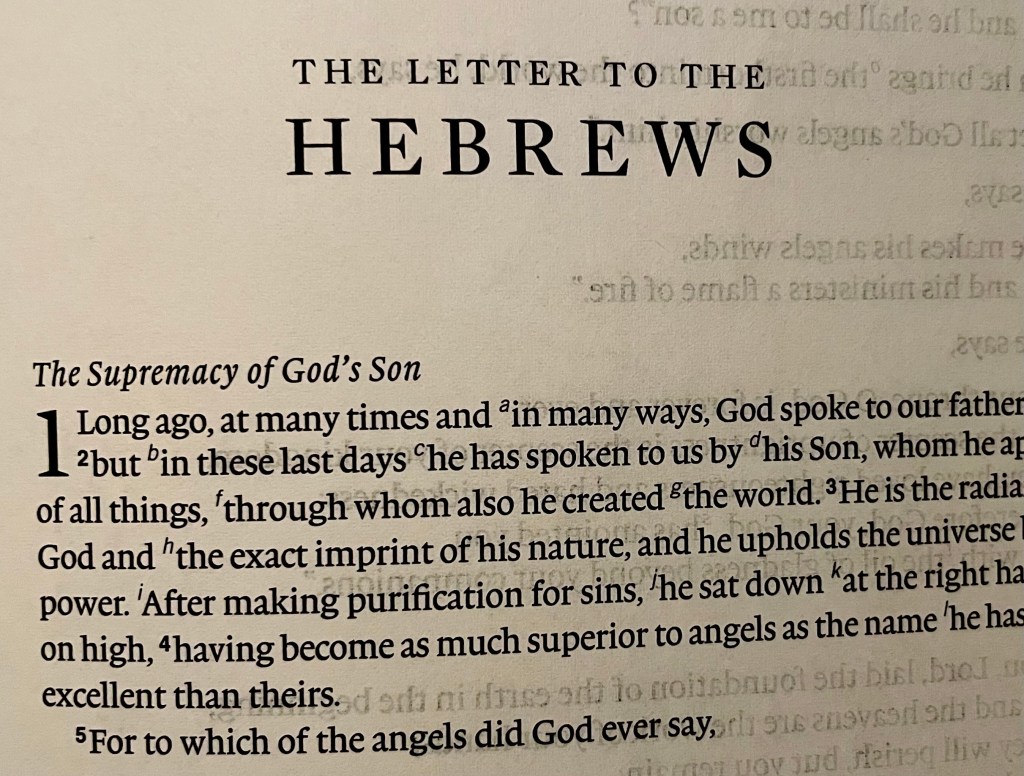
“Long ago, at many times and in many ways, God spoke to our fathers by the prophets but in these last days he has spoken to us by his Son whom he has appointed the heir of all things through whom he created the world. He is the radiance of the glory of God and the exact imprint of his nature, and he upholds the universe by the word of his power.”
There is so much said in this opening statement. The author illuminates the contrasts:
•long ago v. these last days
•God spoke many times in many ways v. once and for all
•our fathers v. us
•the prophets v. the Son
It identifies what was needed during the Old Testament period and what has become in the New Testament.
Under the first covenant, God spoke to us by the prophets, by the Levite priests who have earthly heritage, by the law “that appoints men in their weakness” and “has but a shadow of the good things to come instead of the true form of these realities”. At that time the way into the holy places was not yet opened. The curtain was drawn to the Most Holy Place in the tabernacle.
But now, in the new covenant, God speaks to us through His Son who has no beginning or end, who is a forever king (fully man), a forever priest (fully God), who is perfect forever. Christ opened for us, “the new and living way through the curtain, that is, through his flesh.”
Chapter 8, verse 10 describes how through his flesh, our flesh and soul will be transformed, saying beautifully:
“I will put my laws into their minds, and write them on their hearts, and I will be their God, and they shall be my people.”
This is not a covenant of old where we are to carry out works for redemption. This is a new covenant where the Holy Spirit writes God’s laws and our redemption through Christ on our hearts once and for all.
The author goes on contrasting the old era and the new era:
“For Christ has entered, not into holy places made with hands, which are copies of the true things, but into heaven itself, now to appear in the presence of God on our behalf.”
Notice, again, the contrast of the realities of the Old Covenant and the New Covenant. In the old covenant the law and ceremonies were a shadow of the good things to come. They only reflected the heavenly things. After the work of Christ the heavenly reality not only intrudes into history but Christians actually participate in this new reality. Christians live in a semi-heavenly (semi-eschatological) age and in the Second Coming, God’s people, will fully realize their Sabbath rest. What will Sabbath rest be? It will be “a time, not to deal with sin but to save those who are eagerly waiting for him”. Rest in a sinless age.
For, in the meantime, as the author says:
“we are not of those who shrink back and are destroyed, but of those who have faith and preserve their souls. Now faith is the assurance of things hoped for, the conviction of things not seen.”
C.S. Lewis has said:
“If we find ourselves with a desire that nothing in this world can satisfy, the most probable explanation is that we were made for another world.”
And Hebrews says:
“They desire a better country, that is, a heavenly one.”
Both authors are describing the insufficiency of this earthly homeland and the longing for our true home. I, for one, have always had that longing for a true place of belonging.
And one last beautiful benediction from the author of Hebrews:
“Therefore let us be grateful for receiving a kingdom that cannot be shaken, and thus let us offer to God acceptable worship, with reverence and awe.”
“So we can confidently say, “The Lord is my helper; I will not fear; what can man do to me?”
“Jesus Christ is the same yesterday and today and forever.”
 Witnessing Why